Wednesday, August 19, 2009
"Follow Me" on Twitter
I finally gave into the peer pressure and have started tweeting; you can find me at: http://twitter.com/SalaryCap101. I'll be posting random contract and salary cap nuggets of info there (and of course advertising my Salary Cap 101 webinar) in the process. FYI, I'm teaching a live Salary Cap 101 webinar this Saturday, 8.22.09 @ 1pm EST. Visit http://www.salarycap101.com/ for more information and to register.


Friday, August 14, 2009
The Contracts of Mike Vick & Roddy White
Vick’s Contract Structure
On the first night of the first full weekend of pre-season football, the games of the evening took a backseat to the signing of quarterback Michael Vick by the Philadelphia Eagles. While the numbers are generally being reported by various outlets as $1.6 million for year one and $5.2 million for the option year of year two, I’ll reserve comment on the compensation aspect of the deal until I can get the specific details of the contract, as the numbers reported are very vague and tell one nothing about how those amounts are broken out amongst guaranteed and non-guaranteed money.
Regarding the reported structure of the contract, in an article that I penned for the The Washington Post, I discussed the advantages of signing Vick to a one-year “prove it” contract with a club option for multiple years thereafter. In the end, Vick and the Eagles did indeed agree to this type of structure, but instead of an option for multiple years, Vick’s agreement is only for one option year. Without re-hashing the Washington Post article, the spirit of the “prove-it” option structure is that it allows the club to get a one year evaluation of the player, without the commitment of a substantial amount of guaranteed money and contractual years, and more importantly, this structure allows the club to be in complete control should they decide they would like to retain the player after year one. In his one year with the Patriots, Donte Stallworth signed a one year “prove it” contract with an option for multiple years thereafter; the Patriots chose not to exercise the option. Conversely, Saints quarterback Drew Brees also signed a contract with this structure after coming off of off-season shoulder surgery; the Saints opted to exercise Brees’ option.
In short, if the player stinks, then with this structure the club doesn’t pay the option bonus and the player becomes a free agent, but if the player turns out to be good, then the club pays the negotiated option bonus and retains the services of the player. If the retention of the player equates to multiple years, then this is to the advantage of the club, as they’ve locked in the future value of the player’s contract. To this point, it makes sense that Vick’s option is only for one additional year. Assuming Vick proves to be a high-level player, then the agent’s responsibility is to get his player to free agency as soon as possible, hence the one option year agreed to by Vick’s agent Joel Segal in lieu of multiple years. If Vick is playing at a high level through 2010, he’ll be in line for a potentially lucrative deal as he enters 2011. However, if Vick proves otherwise, then the club has protected its interests by not committing a lot to Vick beyond 2009.
All in all, the contract structure agreed to by Vick and the Eagles seems to be mutually beneficial. Given the well documented history of the Eagles’ propensity for locking up players for an extended amount of years, it’s interesting that Segal was able to obtain an agreement to one option year. One would have thought that the Eagles would have wanted the option to secure Vick’s services for a longer period of time after the “prove it” year.
Coincidentally, or maybe not, both Eagles starting quarterback Donovan McNabb’s and Vick’s contracts expire after 2010, assuming a Vick option. Come 2011, it’ll be interesting to see which one of these two end up with a new contract with the Eagles as the starter, or if neither is the 2011 starter or on the team for that matter.
Roddy White Analysis
While the NFL news headlines are filled with the signing of a former member of the Atlanta Falcons, lets take a look at the contract signed by current Falcon wide receiver Roddy White.
Wide Receiver Roddy White
Club: ATL
Analysis Peer Group: Wide Receiver Contract Extensions
Contract Length: Five new years
Total Guarantee: $18,600,000 (Peer: BUF Wide Receiver Lee Evans, $18,250,000; New England Wide Receiver Randy Moss, $15,000,000)
Guarantee Per Year: $3,720,000 (Peers: CHI Wide Receiver Devin Hester, $3,750,000; NO Wide Receiver Marques Colston, $3,333,333)
Guarantee vs. Total New Money Value: 43.5% (Peer: ARZ Wide Receiver Anquan Boldin, 44.1%)
Total New Money Value: $42,720,000 (Peers: HST Wide Receiver Andre Johnson, $42,600,000; MIN Wide Receiver Bernard Berrian, $42,000,000)
Average Per Year (APY): $8,544,000 (Peers: DAL Wide Receiver Roy Williams, $9,000,000; Evans, $8,250,000)
Three-Year Total: (estimate) $31,120,000 (Peers: ARZ Wide Receiver Larry Fitzgerald, $33,000,000; Moss, $27,000,000)
Guarantee vs. Three-Year Total: 59.8% (Peers: ATL Wide Receiver Michael Jenkins, 63.4%; Moss, 55.6%)
Analysis:
The first thing that stands out about the contract extension signed by Falcons wide receiver Roddy White is his three-year total of $31,120,000. At the wide receiver position, this amount is only rivaled and surpassed by the contract of Arizona wide receiver Larry Fitzgerald, $33,000,000. This three-year total is an aspect of the contract that White’s agent Neil Schwartz can hang his hat on when selling this contract to the media or prospective clients.
However, from the club’s perspective, this is a good deal because even though Roddy White can earn a lot of money over the course of this contract, particularly over the first three years; he’s going to have to do just that, earn it via salary and not guaranteed money. While players like Saints wide receiver Marques Colston and Bears wide receiver Devin Hester are guaranteed in excess of 85% of the first three years of their contract, White is only guaranteed 59.8% of his three-year total. In the case of White and the Falcons, this agreement benefits the club in that the player should be satisfied with a guarantee amount as a whole that is going to pay him as an upper-tier wide receiver but at the same time doesn’t over expose the club from a guaranteed compensation standpoint should Roddy White’s development regress. Sounds like a win-win deal.
On the first night of the first full weekend of pre-season football, the games of the evening took a backseat to the signing of quarterback Michael Vick by the Philadelphia Eagles. While the numbers are generally being reported by various outlets as $1.6 million for year one and $5.2 million for the option year of year two, I’ll reserve comment on the compensation aspect of the deal until I can get the specific details of the contract, as the numbers reported are very vague and tell one nothing about how those amounts are broken out amongst guaranteed and non-guaranteed money.
Regarding the reported structure of the contract, in an article that I penned for the The Washington Post, I discussed the advantages of signing Vick to a one-year “prove it” contract with a club option for multiple years thereafter. In the end, Vick and the Eagles did indeed agree to this type of structure, but instead of an option for multiple years, Vick’s agreement is only for one option year. Without re-hashing the Washington Post article, the spirit of the “prove-it” option structure is that it allows the club to get a one year evaluation of the player, without the commitment of a substantial amount of guaranteed money and contractual years, and more importantly, this structure allows the club to be in complete control should they decide they would like to retain the player after year one. In his one year with the Patriots, Donte Stallworth signed a one year “prove it” contract with an option for multiple years thereafter; the Patriots chose not to exercise the option. Conversely, Saints quarterback Drew Brees also signed a contract with this structure after coming off of off-season shoulder surgery; the Saints opted to exercise Brees’ option.
In short, if the player stinks, then with this structure the club doesn’t pay the option bonus and the player becomes a free agent, but if the player turns out to be good, then the club pays the negotiated option bonus and retains the services of the player. If the retention of the player equates to multiple years, then this is to the advantage of the club, as they’ve locked in the future value of the player’s contract. To this point, it makes sense that Vick’s option is only for one additional year. Assuming Vick proves to be a high-level player, then the agent’s responsibility is to get his player to free agency as soon as possible, hence the one option year agreed to by Vick’s agent Joel Segal in lieu of multiple years. If Vick is playing at a high level through 2010, he’ll be in line for a potentially lucrative deal as he enters 2011. However, if Vick proves otherwise, then the club has protected its interests by not committing a lot to Vick beyond 2009.
All in all, the contract structure agreed to by Vick and the Eagles seems to be mutually beneficial. Given the well documented history of the Eagles’ propensity for locking up players for an extended amount of years, it’s interesting that Segal was able to obtain an agreement to one option year. One would have thought that the Eagles would have wanted the option to secure Vick’s services for a longer period of time after the “prove it” year.
Coincidentally, or maybe not, both Eagles starting quarterback Donovan McNabb’s and Vick’s contracts expire after 2010, assuming a Vick option. Come 2011, it’ll be interesting to see which one of these two end up with a new contract with the Eagles as the starter, or if neither is the 2011 starter or on the team for that matter.
Roddy White Analysis
While the NFL news headlines are filled with the signing of a former member of the Atlanta Falcons, lets take a look at the contract signed by current Falcon wide receiver Roddy White.
Wide Receiver Roddy White
Club: ATL
Analysis Peer Group: Wide Receiver Contract Extensions
Contract Length: Five new years
Total Guarantee: $18,600,000 (Peer: BUF Wide Receiver Lee Evans, $18,250,000; New England Wide Receiver Randy Moss, $15,000,000)
Guarantee Per Year: $3,720,000 (Peers: CHI Wide Receiver Devin Hester, $3,750,000; NO Wide Receiver Marques Colston, $3,333,333)
Guarantee vs. Total New Money Value: 43.5% (Peer: ARZ Wide Receiver Anquan Boldin, 44.1%)
Total New Money Value: $42,720,000 (Peers: HST Wide Receiver Andre Johnson, $42,600,000; MIN Wide Receiver Bernard Berrian, $42,000,000)
Average Per Year (APY): $8,544,000 (Peers: DAL Wide Receiver Roy Williams, $9,000,000; Evans, $8,250,000)
Three-Year Total: (estimate) $31,120,000 (Peers: ARZ Wide Receiver Larry Fitzgerald, $33,000,000; Moss, $27,000,000)
Guarantee vs. Three-Year Total: 59.8% (Peers: ATL Wide Receiver Michael Jenkins, 63.4%; Moss, 55.6%)
Analysis:
The first thing that stands out about the contract extension signed by Falcons wide receiver Roddy White is his three-year total of $31,120,000. At the wide receiver position, this amount is only rivaled and surpassed by the contract of Arizona wide receiver Larry Fitzgerald, $33,000,000. This three-year total is an aspect of the contract that White’s agent Neil Schwartz can hang his hat on when selling this contract to the media or prospective clients.
However, from the club’s perspective, this is a good deal because even though Roddy White can earn a lot of money over the course of this contract, particularly over the first three years; he’s going to have to do just that, earn it via salary and not guaranteed money. While players like Saints wide receiver Marques Colston and Bears wide receiver Devin Hester are guaranteed in excess of 85% of the first three years of their contract, White is only guaranteed 59.8% of his three-year total. In the case of White and the Falcons, this agreement benefits the club in that the player should be satisfied with a guarantee amount as a whole that is going to pay him as an upper-tier wide receiver but at the same time doesn’t over expose the club from a guaranteed compensation standpoint should Roddy White’s development regress. Sounds like a win-win deal.
Thursday, August 6, 2009
Eli Manning: Elite Quarterback?
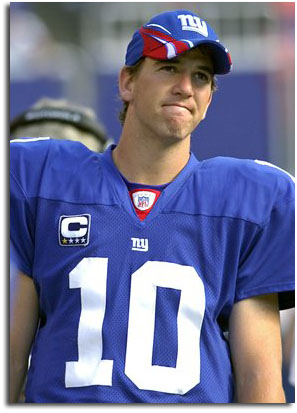
On Wednesday, word broke of the contract extension of Giants quarterback Eli Manning. Unlike free agent contracts or draft pick contracts, when one determines the value of an extension contract, they must subtract from the total value of the contract, the amount of money the player was due to earn on their previous contract over the common years of both contracts. In the case of Manning, 2009 was the final year of his rookie contract, in which he was due to earn $9.4 million. The contract signed by Manning this week was reported as a seven year agreement with a total value of $106.9 million. Subtracting out the $9.4 million of old money and the old year of 2009; Manning’s contract is valued as six-new years with a new money value of $97.5 million.
Another interesting aspect of contract extensions is that they often lead to the lowering of a player’s cap number; meaning Manning’s 2009 cap number of $13.8 million could possibly have been reduced as a result of a contract that has made him a richer man. How does this happen you may ask? Often the money that is guaranteed to the player is accounted for in the future years of the new contract, thereby reducing the player’s impact on the club’s cap in the first year of the deal. Given that the Giants, as of the date of this posting, have only $4 million in cap space, I’m almost certain that Manning’s new contract is providing the club a few million in cap relief.
Below is an analysis of Manning’s contract relative to other quarterbacks who have signed contract extensions. You’ll see that it’s definitely a lucrative contract and a top-market deal, but it may not necessarily be the market setting contract that it’s being made out to be.
QB ELI MANNING
Club: NYG
Analysis Peer Group: QB Contract Extensions
Contract Length: 6 new years
Total Guarantee: (reported) $35,000,000 (Peers: IND QB Peyton Manning, $34,500,000; PIT QB Ben Roethlisberger, $33,200,000)
Guarantee Per Year: $5,833,333 (Peers: NE QB Tom Brady, $6,625,000; Roethlisberger, $5,533,333)
Guarantee vs. Total New Money Value: 35.9% (Peers: DAL QB Tony Romo, 43.4%; Roethlisberger, 37.7%)
Total New Money Value: (reported) $97,500,000 (Peers: Manning, $98,000,000; Palmer, $97,000,000)
Average Per Year (APY): $16,250,000 (Peers: Palmer, $16,166,667; Roethlisberger, $14,664,417)
Three-Year Total: (estimate) $50,000,000 (Peers: Palmer, $55,500,000; Roethlisberger, $52,686,501)
Analysis:
As I looked at putting into context quarterback Eli Manning’s 6-year, $97.5 million contract, it really made me appreciate the contract that Bengals quarterback Carson Palmer got in 2005. Four seasons ago, Palmer got a 6-year extension worth $97 million in new money; fast forward four seasons and Manning essentially gets the same contract with the difference being the guaranteed money. Palmer’s 2005 contract awarded him $24 million guaranteed, while Manning’s contract awards him $35 million.
Given the $40-plus million guarantees of defensive tackle Albert Haynesworth and number-one overall pick, quarterback Matthew Stafford, one would think that a franchise quarterback extension would garner Manning a guarantee in excess of $40 million. However, coincidentally or not, if you analyze Haynesworth’s $41 million guarantee over his seven contract years, it gives you a guarantee per year of $5.86 million. Comparatively, Manning’s $35 million guarantee over six years equates to $5.83 million; so it would appear that $5.8 million per year is a data point that equates to elite guaranteed money. Some say that Patriots quarterback Tom Brady is underpaid, but given his four-year extension signed in 2005, he did pretty well from a guarantee per year standpoint, with a figure of $6.625 million.
The Three-Year Total, which represents the amount of new money the player will have earned over the first three new years of the contract, of Manning’s contract has not been reported, but if Palmer got $55.5 million in 2005 and Roethlisberger $52.7 million in 2008, then one would imagine that Manning’s Three-Year Total has to be in excess of $55 million. Roethlisberger’s Three-Year Total versus his Total New Money of $88 million gives you 59.9% of Roethlisberger’s new money being paid in the first three new years of the deal. Using that 59.9% figure and applying it to Manning’s $97.5 million contract, gives you $58.4 million of Manning’s new money being paid in the first three years if it’s similar to Roethlisberger. It’ll be interesting to find out what Manning’s actual Three-Year Total turns out to be and how similar or dissimilar it is from his peers.
So what does this contract mean for Chargers quarterback Philip Rivers? Since becoming the Chargers’ starter in 2006, Rivers has been by far the more prolific quarterback of the 2004 quarterback draft class (Manning, Rivers, & Roethlisberger). Since 2006, Rivers ranks fifth in cumulative quarterback rating (93.5), while Roethlisberger (85.7) and Manning (78.9) rank 17th and 28th respectively. Clearly, Roethlisberger’s two Super Bowl rings and Manning’s one set these two quarterbacks apart from Rivers; however, Rivers’ 33-15 record as a starter shows that he’s not just putting up numbers but also leading his team to victories just as his quarterback peers of the 2004 draft class. Given the contracts given to Manning and Roethlisberger and given Rivers’ statistics and win-loss record, it would not be unreasonable for a Rivers contract to approach $40 million guaranteed and $100 million in new money. Sounds a lot like the Haynesworth contract; however, unlike the Haynesworth deal which is seven years in duration (although it’s truly a four-year, $48 million contract before a hefty bonus for the remaining three years), the Rivers deal I would expect to be a six year contract as this seems to be the popular contract term for quarterbacks. Romo, Roethlisberger, Cassel, and Palmer all signed six year extensions.
Being a quarterback in the insatiable media market that is New York City is a tough undertaking; not to mention the pressures that come with being a number one overall pick and being the sibling of arguably the most prolific quarterback of this generation. Thus far, winning a Super Bowl has arguably been Manning’s only saving grace because statistically his numbers don’t exactly equate to elite quarterback status. Yet, the Giants awarded Manning a contract that pays him at an elite level. With this new contract, there’s a certain renewing of the pressure on Manning to live up to lofty expectations; I’m sure the New York media will be watching closely.
Another interesting aspect of contract extensions is that they often lead to the lowering of a player’s cap number; meaning Manning’s 2009 cap number of $13.8 million could possibly have been reduced as a result of a contract that has made him a richer man. How does this happen you may ask? Often the money that is guaranteed to the player is accounted for in the future years of the new contract, thereby reducing the player’s impact on the club’s cap in the first year of the deal. Given that the Giants, as of the date of this posting, have only $4 million in cap space, I’m almost certain that Manning’s new contract is providing the club a few million in cap relief.
Below is an analysis of Manning’s contract relative to other quarterbacks who have signed contract extensions. You’ll see that it’s definitely a lucrative contract and a top-market deal, but it may not necessarily be the market setting contract that it’s being made out to be.
QB ELI MANNING
Club: NYG
Analysis Peer Group: QB Contract Extensions
Contract Length: 6 new years
Total Guarantee: (reported) $35,000,000 (Peers: IND QB Peyton Manning, $34,500,000; PIT QB Ben Roethlisberger, $33,200,000)
Guarantee Per Year: $5,833,333 (Peers: NE QB Tom Brady, $6,625,000; Roethlisberger, $5,533,333)
Guarantee vs. Total New Money Value: 35.9% (Peers: DAL QB Tony Romo, 43.4%; Roethlisberger, 37.7%)
Total New Money Value: (reported) $97,500,000 (Peers: Manning, $98,000,000; Palmer, $97,000,000)
Average Per Year (APY): $16,250,000 (Peers: Palmer, $16,166,667; Roethlisberger, $14,664,417)
Three-Year Total: (estimate) $50,000,000 (Peers: Palmer, $55,500,000; Roethlisberger, $52,686,501)
Analysis:
As I looked at putting into context quarterback Eli Manning’s 6-year, $97.5 million contract, it really made me appreciate the contract that Bengals quarterback Carson Palmer got in 2005. Four seasons ago, Palmer got a 6-year extension worth $97 million in new money; fast forward four seasons and Manning essentially gets the same contract with the difference being the guaranteed money. Palmer’s 2005 contract awarded him $24 million guaranteed, while Manning’s contract awards him $35 million.
Given the $40-plus million guarantees of defensive tackle Albert Haynesworth and number-one overall pick, quarterback Matthew Stafford, one would think that a franchise quarterback extension would garner Manning a guarantee in excess of $40 million. However, coincidentally or not, if you analyze Haynesworth’s $41 million guarantee over his seven contract years, it gives you a guarantee per year of $5.86 million. Comparatively, Manning’s $35 million guarantee over six years equates to $5.83 million; so it would appear that $5.8 million per year is a data point that equates to elite guaranteed money. Some say that Patriots quarterback Tom Brady is underpaid, but given his four-year extension signed in 2005, he did pretty well from a guarantee per year standpoint, with a figure of $6.625 million.
The Three-Year Total, which represents the amount of new money the player will have earned over the first three new years of the contract, of Manning’s contract has not been reported, but if Palmer got $55.5 million in 2005 and Roethlisberger $52.7 million in 2008, then one would imagine that Manning’s Three-Year Total has to be in excess of $55 million. Roethlisberger’s Three-Year Total versus his Total New Money of $88 million gives you 59.9% of Roethlisberger’s new money being paid in the first three new years of the deal. Using that 59.9% figure and applying it to Manning’s $97.5 million contract, gives you $58.4 million of Manning’s new money being paid in the first three years if it’s similar to Roethlisberger. It’ll be interesting to find out what Manning’s actual Three-Year Total turns out to be and how similar or dissimilar it is from his peers.
So what does this contract mean for Chargers quarterback Philip Rivers? Since becoming the Chargers’ starter in 2006, Rivers has been by far the more prolific quarterback of the 2004 quarterback draft class (Manning, Rivers, & Roethlisberger). Since 2006, Rivers ranks fifth in cumulative quarterback rating (93.5), while Roethlisberger (85.7) and Manning (78.9) rank 17th and 28th respectively. Clearly, Roethlisberger’s two Super Bowl rings and Manning’s one set these two quarterbacks apart from Rivers; however, Rivers’ 33-15 record as a starter shows that he’s not just putting up numbers but also leading his team to victories just as his quarterback peers of the 2004 draft class. Given the contracts given to Manning and Roethlisberger and given Rivers’ statistics and win-loss record, it would not be unreasonable for a Rivers contract to approach $40 million guaranteed and $100 million in new money. Sounds a lot like the Haynesworth contract; however, unlike the Haynesworth deal which is seven years in duration (although it’s truly a four-year, $48 million contract before a hefty bonus for the remaining three years), the Rivers deal I would expect to be a six year contract as this seems to be the popular contract term for quarterbacks. Romo, Roethlisberger, Cassel, and Palmer all signed six year extensions.
Being a quarterback in the insatiable media market that is New York City is a tough undertaking; not to mention the pressures that come with being a number one overall pick and being the sibling of arguably the most prolific quarterback of this generation. Thus far, winning a Super Bowl has arguably been Manning’s only saving grace because statistically his numbers don’t exactly equate to elite quarterback status. Yet, the Giants awarded Manning a contract that pays him at an elite level. With this new contract, there’s a certain renewing of the pressure on Manning to live up to lofty expectations; I’m sure the New York media will be watching closely.
Tuesday, July 28, 2009
Is Matt Cassel the Next Tony Romo?

In the valuing of NFL contracts there are standard metrics by which both clubs and agents utilize to determine the comparative value of contracts. The metrics most often publicized are guaranteed money and total contract value. While these metrics are most certainly important, particularly total guaranteed money, these are not the only metrics used.
Another metric is Average Per Year, which in the case of a free agent contract or draft pick contract is simply the total value of the contract divided by the length of the contract. However, when determining Average Per Year in a contract renegotiation or extension, the formula is total value minus the remaining money to be earned on the previous contract divided by the total new years of the contract. In the example of a player with one year left on his contract who signs a five-year contract, there are four new years, thereby making it a four-year extension. The Average Per Year is then representative of the new money per new contract year.
The metric of 3-Year Total is simply how much money will the player have made if the team were to terminate the contract after three years. This metric speaks to whether or not a contract is front or back loaded. For example, two players both sign five-year contracts worth $50 million with the same guarantee. Using the Average Per Year metric, these contracts are equal. However, lets say that in player A’s contract he’s slated to make $40 million in the first three years and then slated to make $10 million over the final two years , while player B is slated to make $20 million in the first three years and the remaining $30 million over the final two years. The 3-Year Total metric makes this distinction and shows that player A’s contract is superior to player B’s, even though the Average Per Year metric shows that they are equal.
Another metric that distinguishes contracts from one another is the Guarantee Per Year metric. This metric accounts for the length of the contract as it relates to guaranteed money. Obviously two players who both receive $20 million in guaranteed money are in a great positions; however, if player A’s contract is for seven years while player B’s contract is for four years, then player B has the more favorable deal, all things equal.
As you read the analysis of the Matt Cassel contract below, you’ll see me reference these metrics and who the players are that are most comparable to Cassel in each of these metrics.
Another metric is Average Per Year, which in the case of a free agent contract or draft pick contract is simply the total value of the contract divided by the length of the contract. However, when determining Average Per Year in a contract renegotiation or extension, the formula is total value minus the remaining money to be earned on the previous contract divided by the total new years of the contract. In the example of a player with one year left on his contract who signs a five-year contract, there are four new years, thereby making it a four-year extension. The Average Per Year is then representative of the new money per new contract year.
The metric of 3-Year Total is simply how much money will the player have made if the team were to terminate the contract after three years. This metric speaks to whether or not a contract is front or back loaded. For example, two players both sign five-year contracts worth $50 million with the same guarantee. Using the Average Per Year metric, these contracts are equal. However, lets say that in player A’s contract he’s slated to make $40 million in the first three years and then slated to make $10 million over the final two years , while player B is slated to make $20 million in the first three years and the remaining $30 million over the final two years. The 3-Year Total metric makes this distinction and shows that player A’s contract is superior to player B’s, even though the Average Per Year metric shows that they are equal.
Another metric that distinguishes contracts from one another is the Guarantee Per Year metric. This metric accounts for the length of the contract as it relates to guaranteed money. Obviously two players who both receive $20 million in guaranteed money are in a great positions; however, if player A’s contract is for seven years while player B’s contract is for four years, then player B has the more favorable deal, all things equal.
As you read the analysis of the Matt Cassel contract below, you’ll see me reference these metrics and who the players are that are most comparable to Cassel in each of these metrics.
QB Matt Cassel
Club: KC
Contract Length: 6 years
Total Guarantee: $27,750,000
Guarantee Per Year: $4,625,333
Total Value of Contract Guaranteed: 44%
Comparable Total Guarantees at Position: OAK QB JaMarcus Russell, $32,000,000; DAL QB Tony Romo, $29,294,118; NE QB Tom Brady, $26,500,000; CIN QB Carson Palmer, $24,000,000
Total Value: $63,000,000
Average Per Year (APY): $10,500,000
Comparable APYs at Position: ATL QB Matt Ryan, $11,000,000; SL QB Marc Bulger, $10,841,667; OAK QB JaMarcus Russell, $10,166,667; NO QB Drew Brees, $10,000,000
3-Year Total: $40,500,000
Analysis:
As you assess Chiefs quarterback Matt Cassel’s contract, you have to compare his contract to his peers, who have also been awarded long-term franchise quarterback contracts with very little track record as an NFL starting quarterback. The most recent examples are Green Bay quarterback Aaron Rodgers and Dallas quarterback Tony Romo. Cleveland quarterback Derek Anderson could be considered in this peer group, but because his deal was only a 3-year contract we’ll exclude him from this analysis.
At the high end of this specific market (from an Average Per Year perspective) is Rodgers, who, relative to this market, was the most inexperienced when he signed his contract. Prior to signing his franchise quarterback contract in November of 2008, Rodgers had only eight career starts (all of them in 2008). Despite this fact, the Packers were so sold on the future of Rodgers that they signed him to a seven-year contract with five new years at an average new money per year of $12,264,000. Rodgers’ guarantee per new year was $4,000,000 (total guarantee was $20,000,000), and his 3-Year Total was $28,000,000. Comparatively, despite a lower Average Per Year, Cassel received a higher total guarantee per year $4,625,333 (as well as a higher total guarantee of $27,750,000). Cassel also surpassed Rodgers’ contract in 3-Year total with $30,500,000 versus $28,000,000 and percentage of the total value guaranteed, 44% versus 33%.
The most lucrative contract of this peer group from a guarantee standpoint is that of Cowboys quarterback Tony Romo; however, Cassel’s contract is fairly similar when you compare the metrics. Prior to signing his franchise quarterback contract, Romo had 17 career starts under his belt. In October of 2007, Romo signed a seven-year contract with six new years. Romo’s average new money per year is $11,250,000, his guarantee per new year is $4,882,353, his Three-Year total is $31,000,000, and the percentage of the total value that was guaranteed was 43 percent. Comparing Cassel in these same metrics, Cassel surpasses Romo in percentage of total value guaranteed, 44 percent versus 43 percent, and Three-Year total, $40,500,000 versus $31,000,000. However, Cassel is slightly lower than Romo in guarantee per year ($4,882,353 versus $4,625,333)and is slightly lower in average per year, $11,250,000 versus $10,500,000. So is Cassel the next Tony Romo? According to his contract, the expectation is for him to be pretty darn close.
The next group of quarterbacks in line for franchise quarterback contracts are New York quarterback Eli Manning and San Diego quarterback Phillip Rivers, but their contracts are going to be in another stratosphere from those signed by Cassel, Rodgers, and Romo, as these two quarterback are significantly more accomplished than the peer group analyzed here (Chicago quarterback Jay Cutler could also be in line for a significant extension if his productivity continues in Chicago as it was in Denver). However, Washington quarterback Jason Campbell and Buffalo quarterback Trent Edwards, if they prove they’re worthy of a long-term deal, could potentially be in the same ball park as Cassel, Romo, and Rodgers.
Possible Contract Structure for Mike Vick

With Michael Vick’s conditional reinstatement, the question is now what club will take a chance on him. Clearly, the question marks that revolve around Vick are what type of player is he today, given that he hasn’t played in the NFL since 2006, and then, from a PR standpoint, how is the fan base going to react to a Vick signing. That said, it’s inevitable that a club is going to take a flyer on Vick, the talent of his past is too enticing for a club not to.
The structuring of a Vick contract is an intriguing dilemma. On one hand, you want to guard against Vick being washed up; while at the same time serving your best interest if Vick doesn’t skip a beat and returns to his Pro Bowl form.
Without talking about the dollar amounts, one way a Vick contract could be structured is similar to that of the contract signed by Saints quarterback Drew Brees when he arrived in New Orleans. Remember when Brees came to New Orleans in 2006, he was coming off a shoulder injury suffered in his final game as a Charger in 2005. The injury required surgery and five months of rehab. It was under those circumstances that Brees signed a one year contract with an option for five additional years. The spirit of this structure was for Brees to prove in 2006 that he was fully recovered from the shoulder injury and capable of being the franchise quarterback that they had hoped for, which would in turn lead the Saints to pay Brees’ 2nd year Option Bonus amount. However, if Brees proved to not be the same quarterback he had been, then the Saints simply would not exercise the Option for the additional five years, resulting in Brees becoming a free agent after one season in New Orleans. In terms of how this structure impacted Brees’ compensation, he was paid an $8 million signing bonus, a 2006 salary of $1.9 million, and a $100,000 workout bonus, meaning if the Saints chose to walk away after 2006, Brees would have cost them $10 million. However, if the Saints chose to exercise the option, they would pay Brees a 2nd year Option bonus of $12 million and have him under contract for an additional five years.
In the case of Vick, you have a player, who, due to incarceration and not injury, has been away from the game for two seasons. However, similar to Brees, Vick has to prove he still has the ability to be a starting quarterback in this league. That said, it would not be far-fetched to think that a club would want to structure a “prove it” contract for Vick that allows the team to try the “Mike Vick experiment” for one year, without obligating them contractually or financially for an extended amount of time. If Vick proves that he still has it, then, similar to the Brees deal, Vick’s contract could be structured to include an Option bonus that compensates him as a starting quarterback and contractually binds him to a team for multiple seasons. Regarding that Option bonus, clubs are unable to collect forfeiture on Option bonuses paid to players who default on their contract. Given this dynamic, clubs now insert language into their bonus language that allows the club to convert this option bonus to signing bonus, as clubs can collect forfeiture on signing bonus amounts in the event of default.
In the case of Brees, his bonus money of $20 million was split 40-60, $8 million in signing bonus (40% of bonus money) and $12 million in Option bonus (60% of bonus money). Given the Vick circumstances, maybe his split is 25-75 or even less, but this structure allows a club to keep its options open.
The structuring of a Vick contract is an intriguing dilemma. On one hand, you want to guard against Vick being washed up; while at the same time serving your best interest if Vick doesn’t skip a beat and returns to his Pro Bowl form.
Without talking about the dollar amounts, one way a Vick contract could be structured is similar to that of the contract signed by Saints quarterback Drew Brees when he arrived in New Orleans. Remember when Brees came to New Orleans in 2006, he was coming off a shoulder injury suffered in his final game as a Charger in 2005. The injury required surgery and five months of rehab. It was under those circumstances that Brees signed a one year contract with an option for five additional years. The spirit of this structure was for Brees to prove in 2006 that he was fully recovered from the shoulder injury and capable of being the franchise quarterback that they had hoped for, which would in turn lead the Saints to pay Brees’ 2nd year Option Bonus amount. However, if Brees proved to not be the same quarterback he had been, then the Saints simply would not exercise the Option for the additional five years, resulting in Brees becoming a free agent after one season in New Orleans. In terms of how this structure impacted Brees’ compensation, he was paid an $8 million signing bonus, a 2006 salary of $1.9 million, and a $100,000 workout bonus, meaning if the Saints chose to walk away after 2006, Brees would have cost them $10 million. However, if the Saints chose to exercise the option, they would pay Brees a 2nd year Option bonus of $12 million and have him under contract for an additional five years.
In the case of Vick, you have a player, who, due to incarceration and not injury, has been away from the game for two seasons. However, similar to Brees, Vick has to prove he still has the ability to be a starting quarterback in this league. That said, it would not be far-fetched to think that a club would want to structure a “prove it” contract for Vick that allows the team to try the “Mike Vick experiment” for one year, without obligating them contractually or financially for an extended amount of time. If Vick proves that he still has it, then, similar to the Brees deal, Vick’s contract could be structured to include an Option bonus that compensates him as a starting quarterback and contractually binds him to a team for multiple seasons. Regarding that Option bonus, clubs are unable to collect forfeiture on Option bonuses paid to players who default on their contract. Given this dynamic, clubs now insert language into their bonus language that allows the club to convert this option bonus to signing bonus, as clubs can collect forfeiture on signing bonus amounts in the event of default.
In the case of Brees, his bonus money of $20 million was split 40-60, $8 million in signing bonus (40% of bonus money) and $12 million in Option bonus (60% of bonus money). Given the Vick circumstances, maybe his split is 25-75 or even less, but this structure allows a club to keep its options open.
Monday, July 27, 2009
Suggs' Contract Analysis & the Future of the Pass-Rushing Defensive End Market

DE TERRELL SUGGS
Club: BLT
Contract Length: 6 years
Total Guarantee: $40,000,000
Guarantee Per Year: $6,666,666
Comparable Total Guarantees at Position: MIN DE Jared Allen, $31,750,069; IND DE Dwight Freeney, $30,000,000; HST DE Mario Williams, $26,500,000; SL DE Chris Long, $24,990,000
Total Value: $62,500,000
Average Per Year (APY): $10,416,666
Comparable APYs at Position: MIN DE Jared Allen, $12,210,012; IND DE Dwight Freeney, $12,000,000; NO DE Will Smith, $10,133,333; SL DE Chris Long, $9,600,000
3-Year Total: $43,400,001
Comparable 3-Year Totals at Position: MIN DE Jared Allen, $38,380,169; IND DE Dwight Freeney, $37,720,000; SL DE Chris Long, $35,000,000; HST DE Mario Williams, $29,450,000
Analysis:
Defensive end Terrell Suggs’ contract is a market setting contract for the pass-rushing defensive end market. Statistically, Suggs is most certainly deserving of a contract that speaks to his stature as one of the best defensive ends in football. I know that on the roster he’s considered a linebacker because of the Ravens’ 3-4 scheme, but coming out of college he was a defensive end and practically speaking in the Ravens’ system, he’s a defensive end. That said, when you compare him statistically to the other top pass rushers, Suggs measures up. Since entering the league in 2003 as a 20-year old, Suggs ranks tied for eighth in sacks with 53. Of that same group of pass-rushers, Suggs’ 368 total tackles since 2003, ranks him fourth, and his 40.5 tackles for a loss over that time period ranks him first. Not to mention last season, he intercepted two passes and took them both back for touchdowns. Simply put, Suggs is a disruptive force on a disruptive defense, and at 26 years of age, there’s a strong chance that, if he remains healthy, Suggs could play the entirety of this contract and at age 32, be in line for another pay day, although probably not at the same dollar amount as his current deal.
So who’s the next player to set the market for pass rushing defensive ends? Carolina defensive end Julius Peppers is most certainly deserving. Since 2003, Peppers ranks second in sacks with 58.5, only trailing Miami defensive end Jason Taylor, who in spite of his one disappointing season in Washington, has 62.5 sacks since 2003. Dallas defensive end DeMarcus Ware has a strong case, as he has 53.5 sacks in the first four years of his career; ranking him first of pass-rushers since 2005. Moreover, his 299 total tackles since coming into the league rank him first amongst pass-rushers, and his 30 tackles for a loss in that time rank him fourth, one and half tackles behind leaders Suggs and Eagles defensive end Trent Cole.
If Washington defensive tackle Albert Haynesworth gets $41 million guaranteed over seven years ($5,857,143 guaranteed per year) and Suggs gets $40 million guaranteed over six years ($6,666,666 guaranteed per year), then look for Ware or Peppers to get at least $42 million to $49 million guaranteed. Regarding Ware, it is Jerry Jones we’re talking about, so Ware could push that $49 million and possibly $50 million guarantee mark.
Club: BLT
Contract Length: 6 years
Total Guarantee: $40,000,000
Guarantee Per Year: $6,666,666
Comparable Total Guarantees at Position: MIN DE Jared Allen, $31,750,069; IND DE Dwight Freeney, $30,000,000; HST DE Mario Williams, $26,500,000; SL DE Chris Long, $24,990,000
Total Value: $62,500,000
Average Per Year (APY): $10,416,666
Comparable APYs at Position: MIN DE Jared Allen, $12,210,012; IND DE Dwight Freeney, $12,000,000; NO DE Will Smith, $10,133,333; SL DE Chris Long, $9,600,000
3-Year Total: $43,400,001
Comparable 3-Year Totals at Position: MIN DE Jared Allen, $38,380,169; IND DE Dwight Freeney, $37,720,000; SL DE Chris Long, $35,000,000; HST DE Mario Williams, $29,450,000
Analysis:
Defensive end Terrell Suggs’ contract is a market setting contract for the pass-rushing defensive end market. Statistically, Suggs is most certainly deserving of a contract that speaks to his stature as one of the best defensive ends in football. I know that on the roster he’s considered a linebacker because of the Ravens’ 3-4 scheme, but coming out of college he was a defensive end and practically speaking in the Ravens’ system, he’s a defensive end. That said, when you compare him statistically to the other top pass rushers, Suggs measures up. Since entering the league in 2003 as a 20-year old, Suggs ranks tied for eighth in sacks with 53. Of that same group of pass-rushers, Suggs’ 368 total tackles since 2003, ranks him fourth, and his 40.5 tackles for a loss over that time period ranks him first. Not to mention last season, he intercepted two passes and took them both back for touchdowns. Simply put, Suggs is a disruptive force on a disruptive defense, and at 26 years of age, there’s a strong chance that, if he remains healthy, Suggs could play the entirety of this contract and at age 32, be in line for another pay day, although probably not at the same dollar amount as his current deal.
So who’s the next player to set the market for pass rushing defensive ends? Carolina defensive end Julius Peppers is most certainly deserving. Since 2003, Peppers ranks second in sacks with 58.5, only trailing Miami defensive end Jason Taylor, who in spite of his one disappointing season in Washington, has 62.5 sacks since 2003. Dallas defensive end DeMarcus Ware has a strong case, as he has 53.5 sacks in the first four years of his career; ranking him first of pass-rushers since 2005. Moreover, his 299 total tackles since coming into the league rank him first amongst pass-rushers, and his 30 tackles for a loss in that time rank him fourth, one and half tackles behind leaders Suggs and Eagles defensive end Trent Cole.
If Washington defensive tackle Albert Haynesworth gets $41 million guaranteed over seven years ($5,857,143 guaranteed per year) and Suggs gets $40 million guaranteed over six years ($6,666,666 guaranteed per year), then look for Ware or Peppers to get at least $42 million to $49 million guaranteed. Regarding Ware, it is Jerry Jones we’re talking about, so Ware could push that $49 million and possibly $50 million guarantee mark.
Thursday, July 16, 2009
Why do players get cut when draft picks get signed?
I know its been a minute since I've posted an entry here and on FootballOutsiders for that matter. The month of June through mid-July is the league's downtime as folks try to recharge their batteries prior to the opening of training camps and the season. So from a news perspective, it's a slow time in the league (aside from Cassel & Suggs' new deals). Anyway, I just wanted to post something real quick.
I was reading how the Browns recently signed three of their draft picks, and as a result of their signing, the Browns cut three players. In the offseason clubs have an 80-man active roster limit to account for clubs wanting to have as many players as possible to compete for roster spots. When clubs select players in the April draft, not only do they sign a contract tender, but the draft picks go on the "Reserve/Selection List" list. The result is them not counting towards this 80-man roster limit, as they are not considered "Active." However, college players who are not drafted and subsequently sign an undrafted rookie free agent contract with a club count as Active and therefore count against the 80-man limit.
So when a drafted player signs his contract, the tender that he signed after the draft goes away and his newly signed contract takes affect; and from a roster count perspective, he moves from Reserve/Selection List to the Active roster. Therefore if a club is at its 80-man limit, a player must be waived from the Active roster in order to make room for the draft pick.
The decision to figure out who to waive is not always a simple decision because clubs like to go into training camp with a certain number of players at a given position to account for saving the legs & reps of veteran players. For example, some clubs like to have 10 wide receivers at the start of camp so as to not burn out the legs of your valuable wide receivers, but having 10 receivers may mean having one less offensive lineman in camp and, to their chagrin, more reps in practice for your veteran offensive linemen.
So signing a draft pick to your Active roster is simple roster management, but you don't want to waive that one player who turns out to be a solid contributor elsewhere thereafter.
I was reading how the Browns recently signed three of their draft picks, and as a result of their signing, the Browns cut three players. In the offseason clubs have an 80-man active roster limit to account for clubs wanting to have as many players as possible to compete for roster spots. When clubs select players in the April draft, not only do they sign a contract tender, but the draft picks go on the "Reserve/Selection List" list. The result is them not counting towards this 80-man roster limit, as they are not considered "Active." However, college players who are not drafted and subsequently sign an undrafted rookie free agent contract with a club count as Active and therefore count against the 80-man limit.
So when a drafted player signs his contract, the tender that he signed after the draft goes away and his newly signed contract takes affect; and from a roster count perspective, he moves from Reserve/Selection List to the Active roster. Therefore if a club is at its 80-man limit, a player must be waived from the Active roster in order to make room for the draft pick.
The decision to figure out who to waive is not always a simple decision because clubs like to go into training camp with a certain number of players at a given position to account for saving the legs & reps of veteran players. For example, some clubs like to have 10 wide receivers at the start of camp so as to not burn out the legs of your valuable wide receivers, but having 10 receivers may mean having one less offensive lineman in camp and, to their chagrin, more reps in practice for your veteran offensive linemen.
So signing a draft pick to your Active roster is simple roster management, but you don't want to waive that one player who turns out to be a solid contributor elsewhere thereafter.
Subscribe to:
Posts (Atom)